I built digitalspoiler.com to solve a specific engineering challenge: bridging the gap between static CRM data and active revenue generation. After years of navigating the manual friction of Salesforce, I realized that modern GTM (Go-to-Market) teams don't need another database; they need an autonomous engine.
The goal was to achieve Level 3 Autonomy—systems that can perceive signals and execute workflows with minimal human intervention. However, building autonomous agents for enterprise sales requires more than just connecting an LLM to the internet. It requires an architecture prioritized around privacy, strategic grounding, and adaptive learning.
Here is how the platform was engineered to be smart, private, and grounded.
1. The Vault: Strict Multi-Tenancy by Design
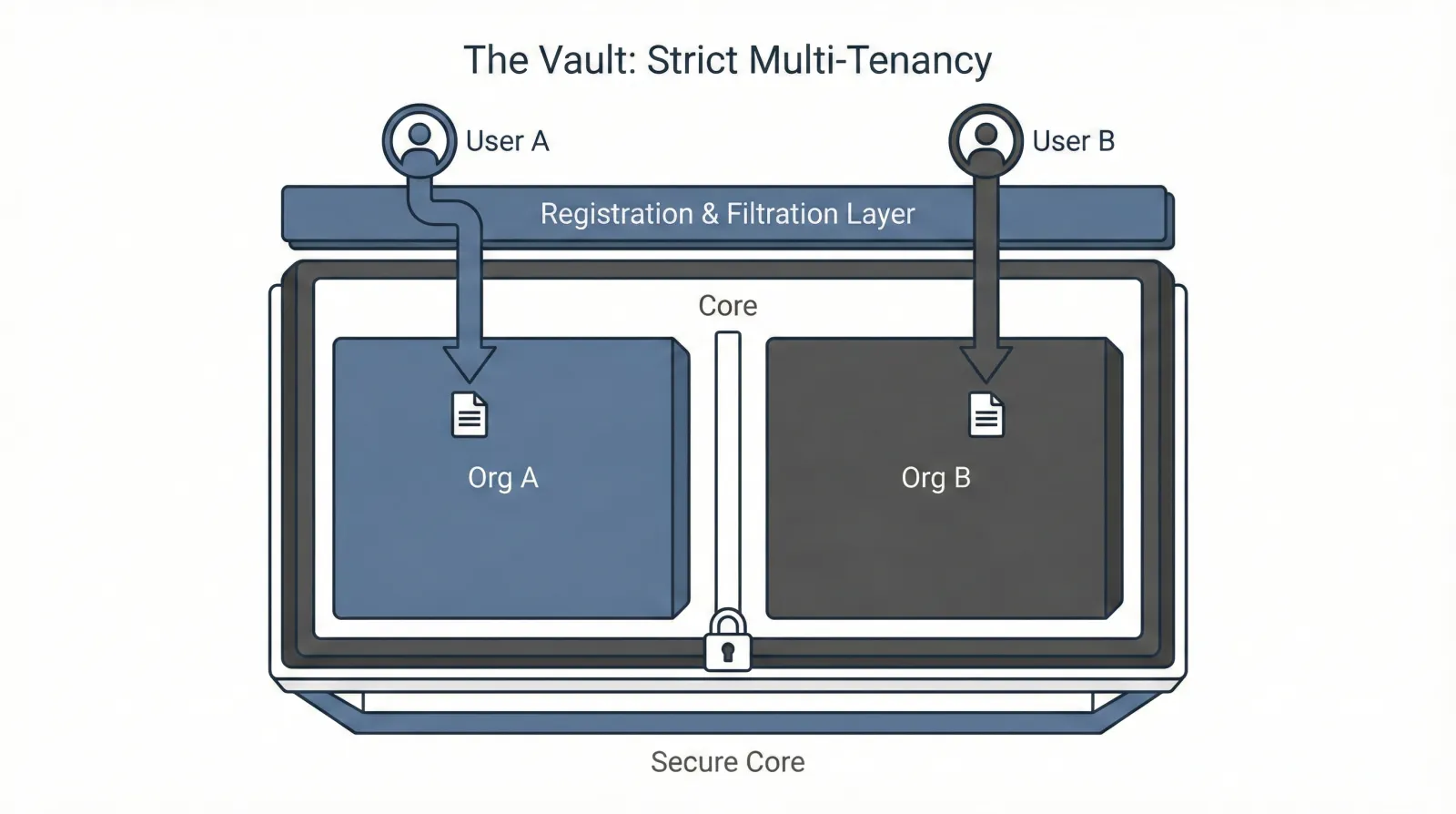
In the enterprise environment, data isolation isn't a feature; it is a prerequisite. Digitalspoiler has been architected with Strict Multi-Tenancy. While many platforms claim privacy, we enforce it via a robust organization ID filtration system initialized at the moment of registration. This ensures two critical outcomes:
- Zero Cross-Sharing: Your deals, contacts, and internal notes are locked within your organization’s specific vault.
- Isolated Intelligence: This prevents "model bleed." An agent optimizing a mission for a Fintech firm never "sees" or "learns" from the proprietary data of a Cybersecurity firm. Your competitive advantage remains exclusively yours.
2. GTM DNA: Creating "Isolated Memory"
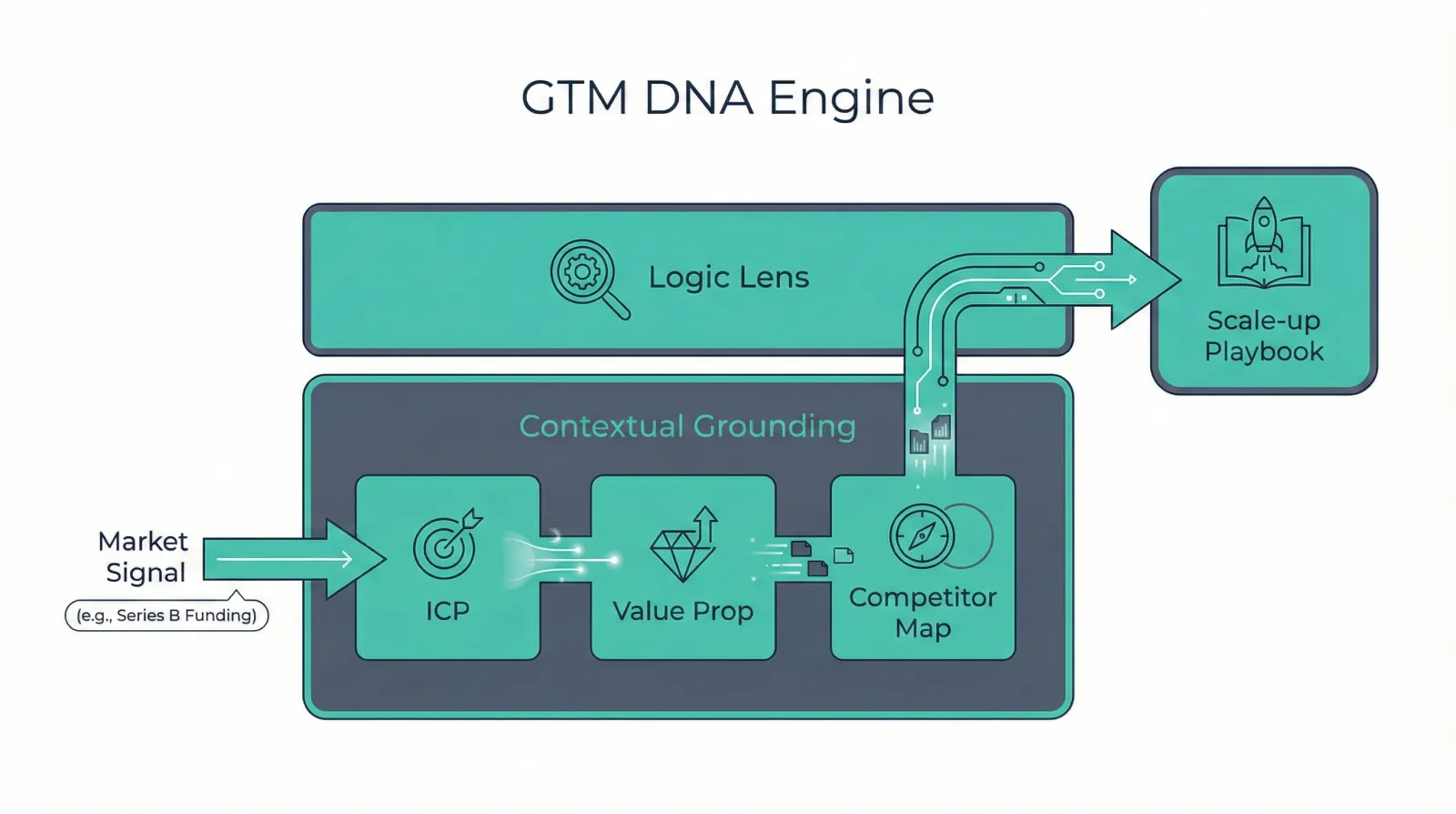
Generic AI produces generic outreach, which kills conversion rates. To solve this, I implemented a layer we call the GTM Profile—effectively the "DNA" of your sales operation.
Every agent is grounded in your specific context via our ContextManager:
- ICP (Ideal Customer Profile): The agent understands exactly who buys from you.
- Value Proposition & Competitive Landscape: It knows the specific pain points you solve and who you are winning against.
Because of this Isolated Memory, a Digitalspoiler agent analyzes news through the lens of your strategy. When it detects a "Series B" funding round, it doesn't just summarize the article; it recognizes the signal and triggers the specific Scale-up Playbook associated with that milestone.
3. The Hybrid RAG Stack: Bridging Global Intelligence
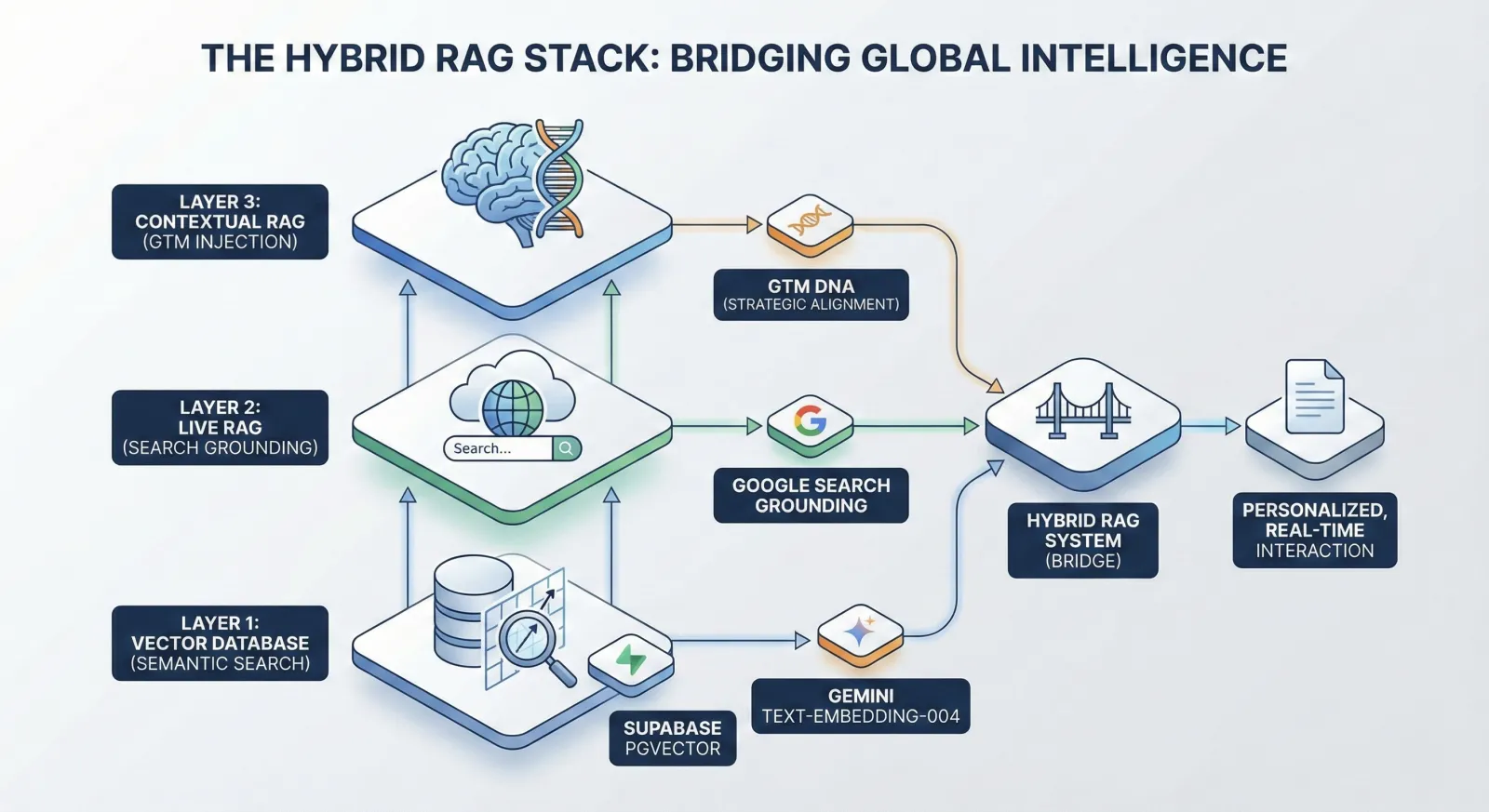
To solve the "Stale Data" problem, we built a three-layered Hybrid RAG (Retrieval-Augmented Generation) system. This acts as the bridge between your internal secrets and global events:
- Vector Database (Semantic Search): Powered by Supabase pgvector and Gemini’s text-embedding-004. It allows for semantic discovery—finding companies based on what they do, not just their name.
- Live RAG (Search Grounding): Our specialists use Google Search Grounding to retrieve real-time data from the web. This ensures the AI never hallucinates old news.
- Contextual RAG (GTM Injection): This layer pulls your GTM DNA into every interaction, ensuring personalization isn't just a placeholder, but a strategic alignment.
4. The Specialist Team: Orchestrated Autonomy
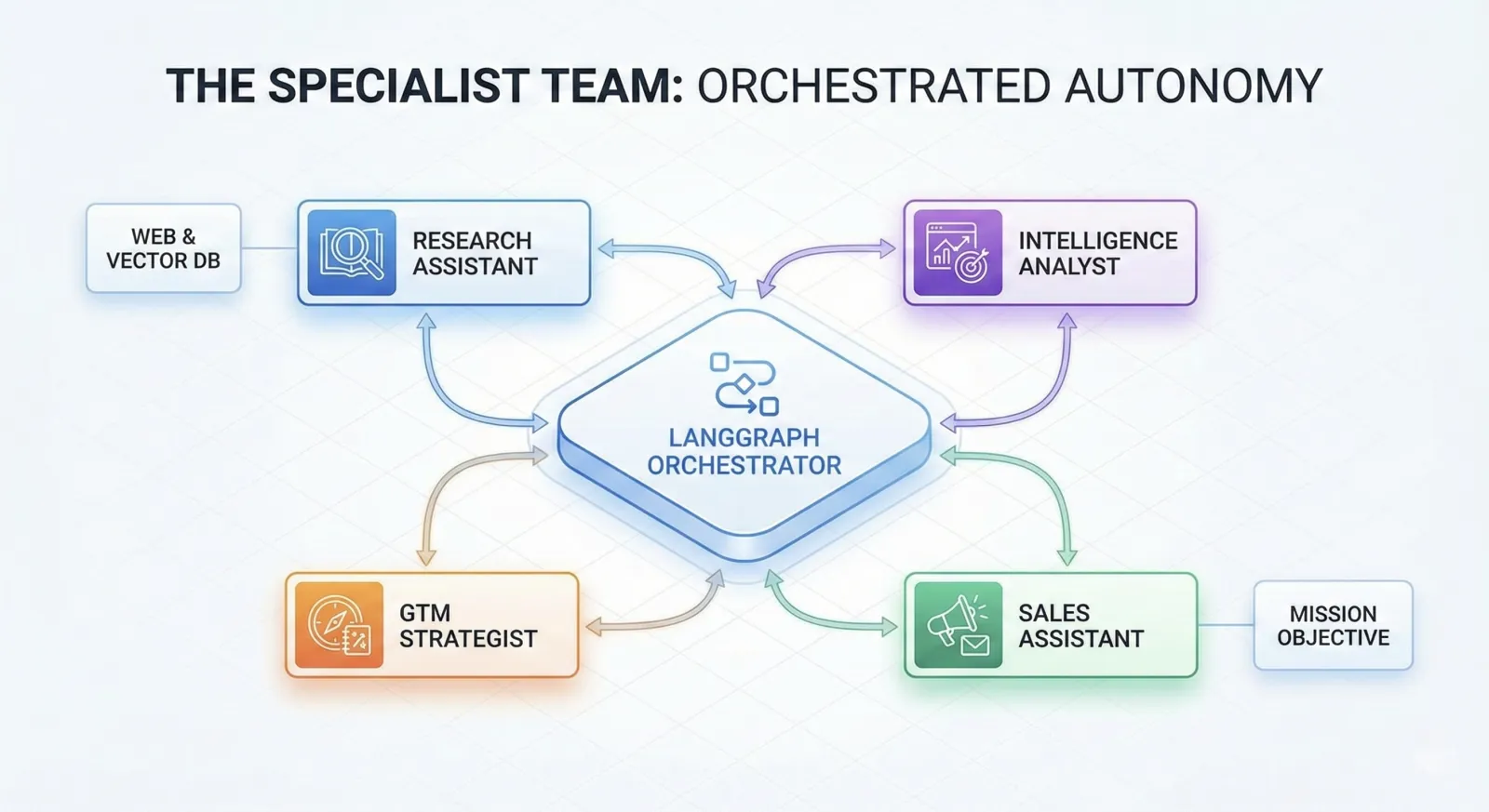
Level 3 Autonomy is achieved by orchestrating a team of specialized agents, each with a distinct "job description":
- Research Assistant: Scours the web and the Vector DB for deep account intelligence.
- Intelligence Analyst: Identifies strategic triggers and buying signals from raw data.
- GTM Strategist: Maps account insights to your specific sales plays and playbooks.
- Sales Assistant: Crafts high-relevance outreach based on the total combined intelligence.
These agents are orchestrated via a stateful LangGraph workflow, allowing them to iterate and collaborate until the mission objective is achieved.
5. The Feedback Loop: Learning from the "Diff"
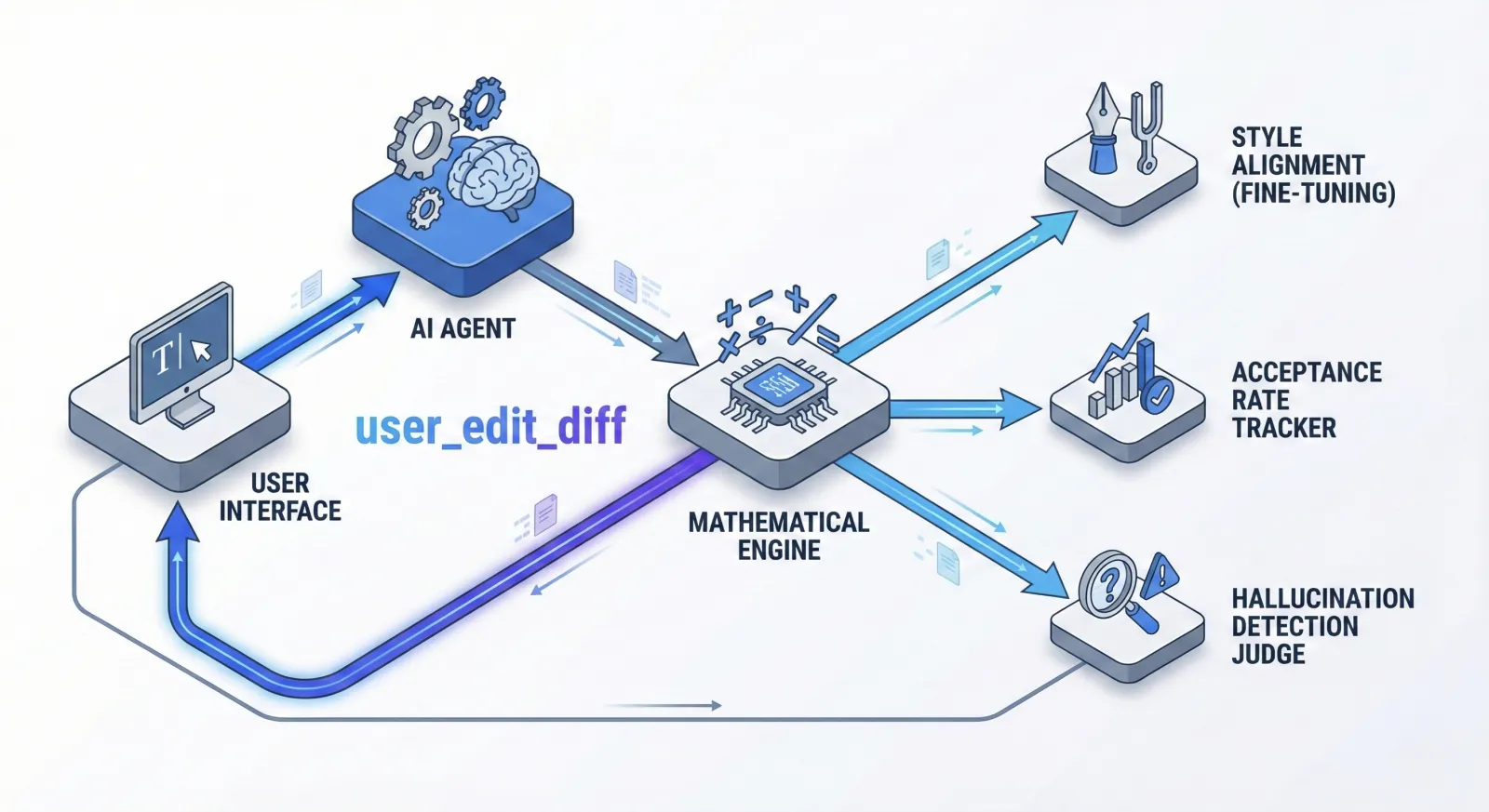
The distinction between a wrapper and a true AI teammate is the ability to adapt. Digitalspoiler utilizes a Human-in-the-Loop (HITL) system that mathematically calculates user preference via the user_edit_diff.
Every time an agent drafts a brief or email, we measure the delta between the AI’s proposal and what you actually sent. This enables three sophisticated behaviors:
- Style Alignment (Gemini Fine-Tuning): These "diffs" are transformed into high-quality training pairs. Over time, the system undergoes fine-tuning to match your specific voice and ROI emphasis.
- Acceptance Rate Optimization: We track how often users hit 'Accept' without editing, validating the agent's evolution.
- Hallucination Detection: If a user deletes specific facts, an LLM Judge analyzes the deletion. If the agent shows a tendency to hallucinate specific data types, a
hallucination_flagis triggered for rapid system correction.
Conclusion: From Tool to Teammate
By combining strict privacy architecture with Hybrid RAG, strategic grounding, and diff-based learning, we've built something that moves past the "Generic Chatbot."
Digitalspoiler is an agent orchestration platform that doesn't just work for you; it learns from you, becoming a private, grounded teammate that speaks your language and watches the world for your next big opportunity.