The Challenge
AGNA Group had high executive curiosity about AI but no shared operating model for how it should apply inside the business. Most leaders had seen ChatGPT, yet there was no common language, no agreed picture of where AI could create value across brands and distribution, and no practical roadmap tied to AGNA's real operating context. The task was to move 70 senior leaders from surface awareness to genuine readiness in one day, using examples anchored in AGNA's supply chain, sales organisation, brand portfolio, outdoor advertising business, and Kosovo expansion.
The Approach
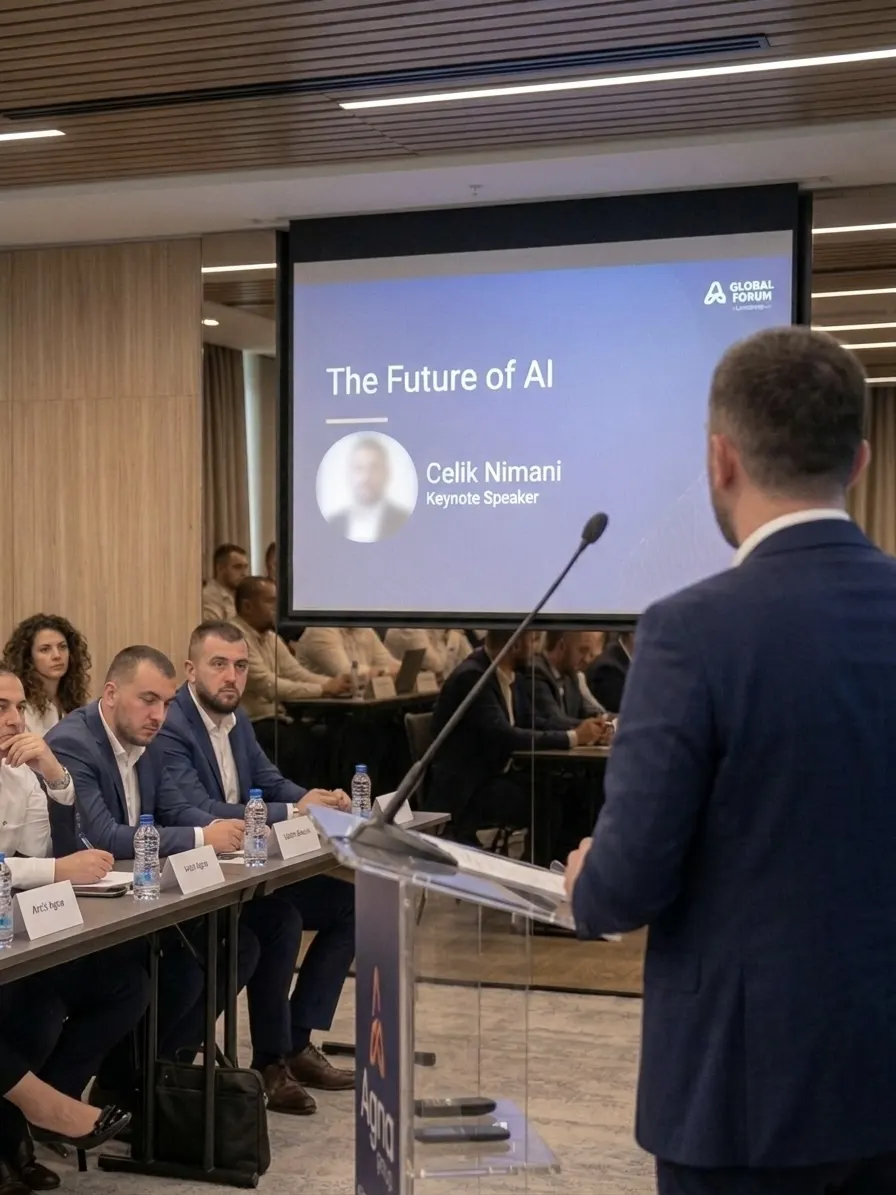
I designed and solo-facilitated a fully customised AI leadership workshop for AGNA Group in Tirana. The program combined executive framing, FMCG-specific market intelligence, AGNA-specific use cases, live agent demonstrations, and role-based exercises for sales and marketing leaders.
Rather than delivering a generic AI overview, the workshop was built around AGNA's actual business system:
The day closed with a shared prioritisation exercise so the room left with named use cases, named owners, and AGNA's first structured AI roadmap.
Key Outcomes
- 01
Leadership Readiness: Moved 70 senior leaders from loose AI awareness to a shared language, mental model, and action frame
- 02
AGNA-Specific Use Cases: Built and pressure-tested practical AI scenarios across supply chain, sales, marketing, finance, HR, and IT
- 03
Agent Skill Transfer: Demonstrated concrete sales and marketing agents that reduced hours of manual research, pipeline review, and briefing work
- 04
Roadmap Ownership: Ended the day with prioritised initiatives, named owners, and an initial AI roadmap aligned to business strategy
- 05
Culture Shift: Reframed AI from a novelty tool into a thinking partner and operating capability for senior decision-makers
Technical Details
1. Designing for AGNA's real operating context
This workshop was not built from a generic deck with the company logo added on top. Every major example, case, and exercise was written specifically for AGNA Group's structure and ambition.
That meant the program directly referenced:
The goal was simple: make it impossible for the room to leave saying, "Interesting, but not relevant to us."
2. Turning awareness into readiness in a single day
The audience included sales leaders, sales directors, marketing directors, and executives with very different levels of AI fluency. Some had never used an AI tool seriously. Others were already experimenting with ChatGPT. The workshop needed to serve both groups without slowing either one down.
The curriculum moved through six connected parts:
This sequencing gave the room both conceptual grounding and a practical path to act.
3. Making the shift from chatbot to agent concrete
One of the key design choices was to make AI agents tangible for leaders who do not think in product or engineering language day to day. Instead of abstract theory, I demonstrated agents around tasks people in the room already own.
The live scenarios included:
This was the mental-model shift that mattered most: away from "AI writes text" and toward "AI helps leaders think, decide, and execute faster."
4. Use cases, risk framing, and strategic prioritisation
The workshop's middle section focused on AGNA-specific use cases across the business. These included demand forecasting for Pepsi and Glina Water, route optimisation for the delivery fleet, predictive maintenance on the bottling line, retail outlet churn prediction, Kosovo campaign localisation, AI-generated weekly management reporting, credit-risk scoring for channel partners, and recruitment screening for field sales roles.
Just as important, the room worked through four risk categories with scenarios grounded in AGNA's context:
The point was not to slow adoption. It was to make adoption responsible, durable, and leadership-owned from the start.
5. What the room left with
By the end of the day, AGNA did not just have enthusiasm. The group had produced working strategic outputs:
Participants also left with practical operator skills: