The Challenge
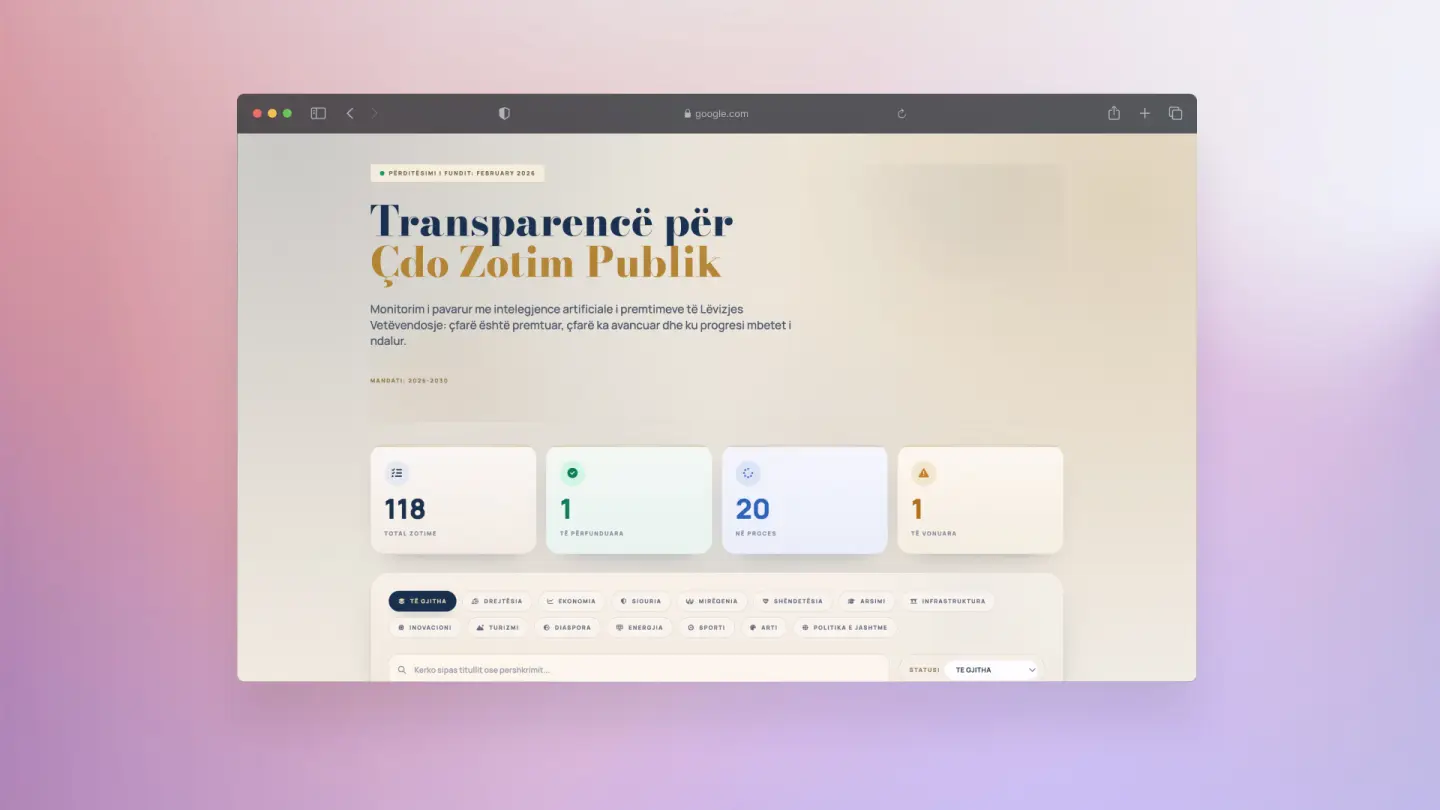
01Holding governments accountable often fails because political manifestos are "static" documents, dense PDFs that are rarely read and even more rarely tracked. In Kosovo, the challenge was to bridge the gap between campaign promises and actual legislative output. I wanted to build a platform that could transform political jargon into a real-time accountability dashboard, moving away from subjective debate and toward data-backed transparency. The objective was to create a "Living Program" where every promise is a tracked data point.
The Approach
02I engineered Zotimi using Codex 5.3 (OpenAI) to build a multi-layered transparency engine. The system begins by deep-parsing political programs to extract granular, actionable promises. These are then monitored by an Autonomous AI Agent that scours institutional updates and news daily.
To ensure absolute accuracy in a sensitive political context, I implemented a Human-in-the-Loop (HITL) verification layer. This allows for automated data collection with a final human "sanity check" before publication. The platform dynamically matches progress to specific Ministers and analyzes Parliamentary transcripts to correlate Deputy performance with stated political goals.
Key Outcomes
03- 01
Automated Accountability: Transformed a 91-page political manifesto into 118+ trackable, real-time promises
- 02
Human-in-the-Loop: Achieved 100% data integrity by combining daily AI agent tracking with human verification
- 03
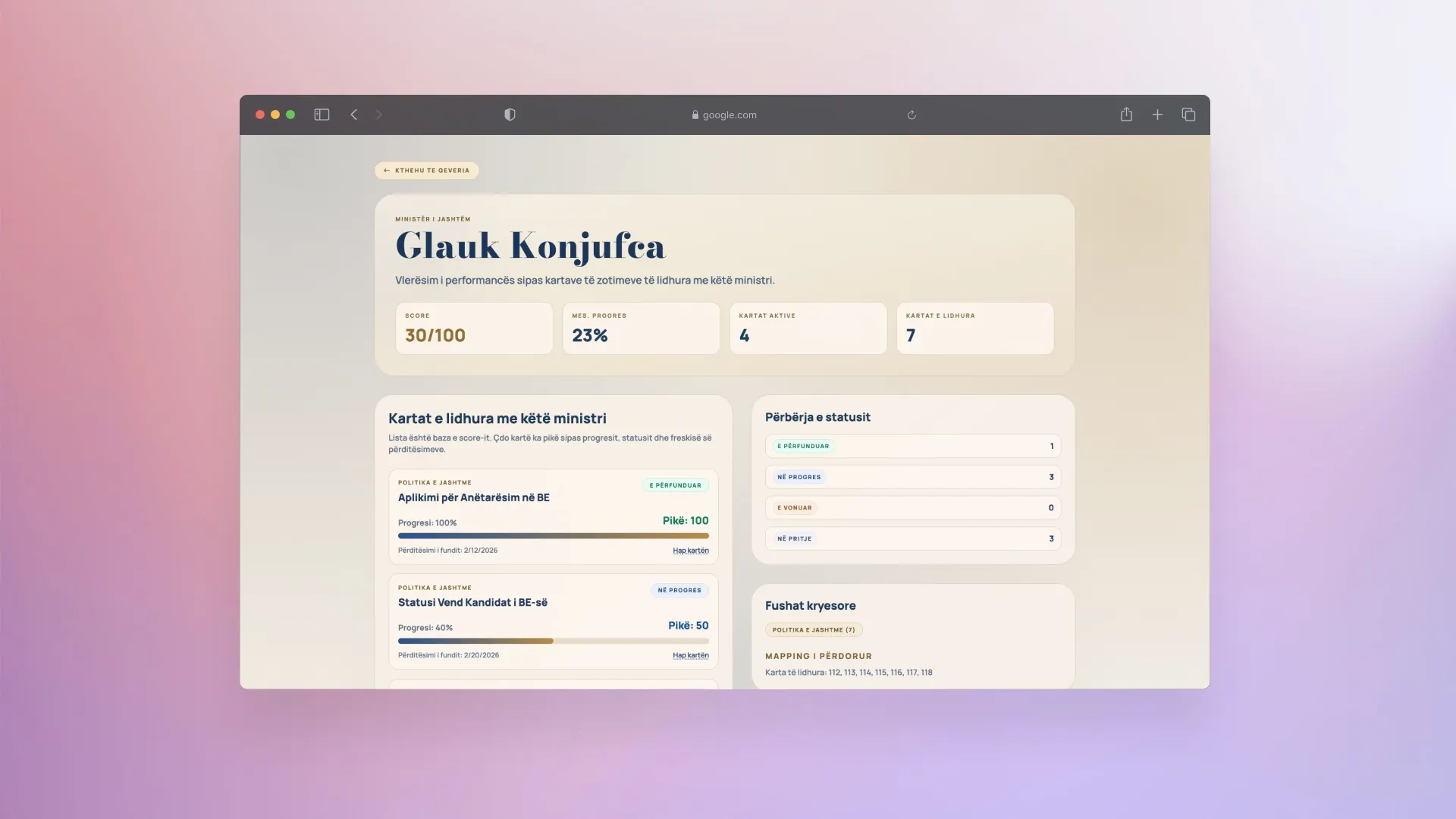
Ministerial Mapping: Developed a performance engine that attributes promise progress (or lack thereof) to specific government officials
- 04
Transcript Intelligence: Automated the analysis of Parliamentary sessions, tracing deputy keywords to promised reforms
- 05
Radical Transparency: Provided citizens with a 1:1 view of government performance versus campaign rhetoric
Technical Details
041. The Promise Engine: Parsing Intent
At the core of Zotimi is a sophisticated parsing engine built with Codex 5.3. Unlike simple keyword matching, the system analyzes the semantic intent of political manifestos. It breaks down broad campaign slogans into specific, measurable goals (e.g., "Improving infrastructure" becomes "Building 20km of the X-Y Highway").
2. Autonomous Daily Tracking
I developed an AI Agent that operates on a 24-hour cycle. It monitors official government portals, gazettes, and reputable news sources to look for Completion Signals. When a signal is detected, the agent drafts a progress update, cites the source, and moves the promise to a Pending Review state.
3. Human-in-the-Loop (HITL) Protocol
In civic tech, a single AI hallucination can damage institutional trust. To solve this, Zotimi uses a "Human-in-the-Loop" workflow. Every AI-generated update must be manually approved. This ensures the platform maintains the neutrality and precision required for public accountability while benefiting from the scale of automated monitoring.
4. Parliamentary Transcript Analysis
One of the most innovative features is the real-time analysis of the Kosovo Parliament transcripts. The system traces the words spoken by deputies during sessions and maps them back to the keywords established in the political program. This allows us to see which deputies are actually advocating for the promises they were elected on.
5. Ministerial Performance Grid
The platform doesn't just track what is being done, but who is doing it. By mapping promises to their corresponding ministries, Zotimi creates a visual Government Heatmap, showcasing which departments are driving progress and which are stalling, fostering a culture of internal accountability within the executive branch.
Technical Implementation
Architecture: Frontend-First Stack
The project is built with a high-performance, frontend-first stack: React 19 + TypeScript, bundled with Vite and routed with Wouter. Styling leverages a hybrid approach of utility classes and custom CSS for distinctive branding and fluid motion. The entire platform is deployed as a static site on Cloudflare Pages, ensuring sub-millisecond load times and maximum security.
Data-First Static Infrastructure
Zotimi uses an intentionally simple but robust architecture:
- Build-Time Pipeline: Instead of a traditional backend API, the app uses a build-time data pipeline to ingest local structured data files.
- Typed Models: Data is structured in strongly typed models (e.g., `PartyPromise` and `deputy-analytics.json`), ensuring consistent taxonomy across the application.
- Transcript Ingestion: Custom scripts (`ingest-transcript-pdf.mjs`) normalize Parliamentary transcripts, map interventions to deputies, and classify content using a sophisticated keyword taxonomy.
- Static Resiliency: This "no-backend" approach eliminates the server attack surface and database overhead, making the platform faster, cheaper to maintain, and highly resilient under traffic spikes.